
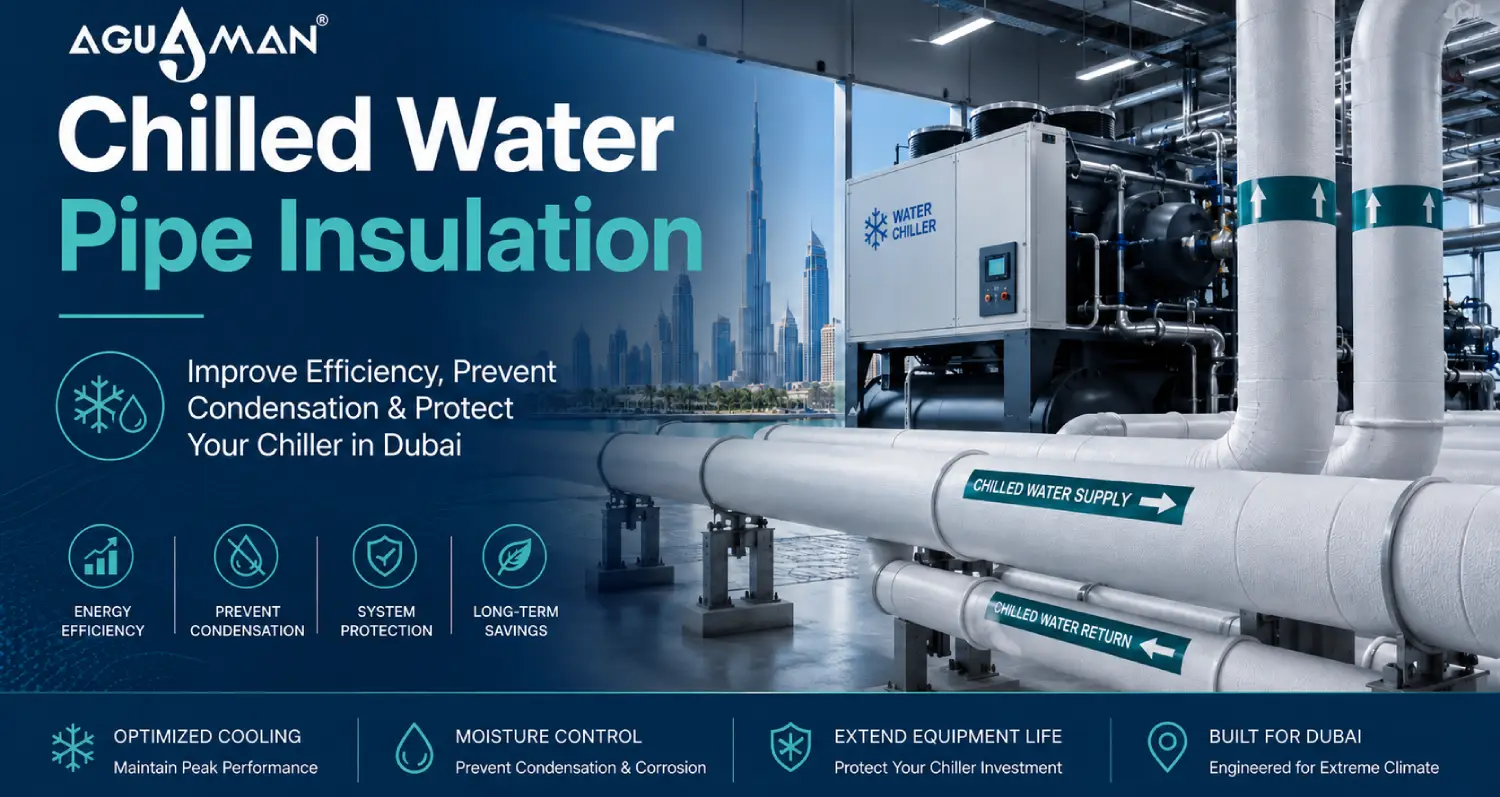
Even the most powerful chiller can experience energy loss from poor insulation or incorrect piping techniques. Inefficient chilled water pipe insulation leads pipes to absorb heat from the environment, creating condensation and causing your cooling system to run overtime.
This issue is especially crucial in Dubai where high ambient temperatures and humidity create unnecessary stress on HVAC and water cooling systems. Adequate insulation preserves your chilled water piping, reduces temperature fluctuations and maximizes efficiency of your chiller system.
What Is Chilled Water Pipe Insulation?
Chilled water pipe insulation is a thermal and moisture resistant blanket that is applied to pipes distributing cold water from a chiller to air-handling units, fan-coil units, process equipment or other destinations.
Insulation reduces the rate of heat transfer between the surrounding air and the chilled water flowing through the pipe. Insulation also helps maintain the outside surface temperature above the dew point of the surrounding air temperature and thereby reduces the potential for condensation. Condensation can be controlled with a properly installed vapor sealed insulation system, efficiency can be increased and wasted energy reduced. (Insulation Institute)
Why Is Chiller Pipe Insulation Important in Dubai?
Climate control challenges in Dubai dictate that chiller pipe insulation be more than just cosmetic. In truth, insulation is a critical component of system design and preventive HVAC maintenance.
It reduces heat gain
Think of it this way – a chilled water pipe loses cooled temperature as it passes through warm spaces like plant rooms, service corridors, ceilings or outdoors.
Without insulation, the pipe temperature rises before it reaches its destination. The chiller must expend more energy to return water to the required temperature. Quality insulation around the pipe helps form a thermal barrier that allows chilled water to maintain ideal temperatures while moving through the distribution system.
It controls condensation
Condensation occurs when warm humid air comes in contact with a cold pipe. Moisture from the air is deposited on the pipe surface, which we often refer to as pipe sweating. Water can drip from the pipe onto ceilings, walls, electrical panels or machinery. In addition, moisture can work its way into damaged insulation over time and promote mold growth, corrosion and a loss of thermal efficiency.
Hot humid climates present a greater chance for moisture intrusion into chilled water insulation systems, especially around poorly sealed joints and fittings . (foamglas.com)
It protects pipes from corrosion
Condensation that becomes trapped under deteriorating or damaged insulation can lead to COFI or corrosion under insulation. Because the piping is concealed, the corrosion can go unnoticed until leaks or severe pipe damage occurs.
Creating a continuous vapor barrier will help minimize moisture penetration. But remember, all joints, valves, elbows, supports and service openings must be properly sealed.
It supports lower operating costs
If water heats up as it travels through your system, the chiller must operate longer or at a higher load to compensate and cool the water back down to the set temperature. Effective insulation helps minimize heat gain throughout the system, allowing for more consistent performance and less unnecessary cooling load.
How Does Chilled Water Pipe Insulation Work?
Insulation creates a barrier around the cold pipe using a material with low thermal conductivity. It reduces heat transfer from the ambient surroundings to the chilled water within the pipe.
A proper insulation system will typically consist of:
- The thermal insulation material itself
- A continuous vapor barrier
- An adhesive/sealant
- External cladding where necessary
- Insulated hangers/supports, valves, flanges & fittings
The vapour barrier plays a key role in any system. Even the highest performing insulation can be compromised by moisture ingress through gaps in joints, damaged insulation or improperly sealed fittings. vapour barrier penetration. Insulation thickness should be determined by considering water temperature, pipe size, conductivity of the insulation material, ambient temperature, relative humidity, application area and project requirements. ASHRAE also states that “minimum thicknesses determined for energy considerations may not be enough to prevent condensation problems. Additional thicknesses or vapor barriers may be required based on actual conditions. (ASHRAE)
Which Materials Are Used for Chilled Water Pipes?
No one insulation material is perfect for every application. Selecting the correct insulation material depends on your operating conditions, location of installation, fire criteria, space constraints and exposure to moisture.
Elastomeric foam
Closed-cell elastomeric foam insulation is common in chilled water applications due to its ability to provide thermal insulation and minimize water-vapor transmission. Its flexibility also allows it to be used around many pipe transitions, valves and smaller diameter pipework. Special attention should still be taken to properly bond and seal all joints to prevent moisture intrusion.
Phenolic or rigid foam insulation
Phenolic and other rigid foam insulation systems offer excellent thermal performance with thinner insulation profiles.
These systems often have more detailed installation requirements and will need a compatible vapor barrier and all joints properly sealed. These systems may also require protective cladding if subjected to excessive wear or exposure.
Fiberglass or mineral-fiber insulation
Sprayed fiberglass and mineral- fiber insulation products are acceptable for chilled water pipes if applied over a continuous vapor- retarder jacket.
Any holes or breaks in the vapor barrier must be patched immediately. Moisture intrusion into fibrous insulation can impair thermal performance.
Cellular glass
Cellular glass can be used where moisture resistance is needed for severe mechanical and industrial applications. Cellular glass also can add functional compressive strength around pipe supports.
The insulation material and method of application should be selected by a qualified HVAC or insulation professional familiar with the project’s actual operating conditions.
What Are the Signs of Failed Chiller Pipe Insulation?
Leaks and insulation failures typically start at joints, elbows, valves, hangers or penetrations that have been cut open for repairs.
Common warning signs include:
- Water droplets forming on the insulation
- Damp ceilings or stains beneath pipe routes
- Torn, cracked or compressed insulation
- Open joints or peeling vapor-barrier tape
- Rust around valves, fittings or pipe supports
- Musty smells near concealed pipework
- Uneven cooling across the building
- A chiller running longer than usual
- Unexpected increases in energy consumption
- Chilled water arriving warmer than the set design temperature
If insulation is found to be wet, it should never be covered up with more insulation. The area should be cut open to expose the leak source and evaluate the condition of the pipe beneath.
Can Damaged Insulation Affect the Chiller?
Yes. While damaged insulation is not necessarily a sign that your chiller has failed, it will contribute to a higher cooling load on your equipment. If your water is absorbing excess heat from uninsulated or poorly insulated pipes, your chiller will need to run longer to meet the same demands which can lead to increased energy usage, poor and fluctuating water temperatures and unnecessary wear on pumps, compressors and controls. Preventative Maintenance Insulation should be checked as part of regular preventative maintenance on your chiller, rather than being considered an aesthetic afterthought.
When Should You Search for Chiller Repair Near Me?
Customers typically only look for services like chiller repair near me once the cooling stops working altogether. Preventative inspections can keep a minor problem from becoming a costly failure.
Professional support should be requested when you notice:
- Reduced cooling performance
- Unusual compressor, fan or pump noise
- Refrigerant or water leakage
- Repeated system alarms
- Incorrect chilled water temperatures
- Excessive condensation on pipes
- Damaged pipe insulation
- Higher electricity consumption
- Frequent chiller cycling
- Poor water circulation
Both the chiller and its distribution system should be checked by a professional. Simply replacing insulation might not remedy the situation if poor water flow, improper controls, a worn pump, refrigerant issues, or wrong system selection is the true culprit.
At Aguaman, they offer installation, commissioning, service, maintenance contracts, remote diagnostics and repair services for our water heating and cooling units. (Aguaman)
How Can the Right Chiller Improve System Performance?
Pipe insulation is only as good as the chiller it works with. When selecting a water cooler, ensure it’s correctly sized to your application’s water temperature, cooling capacity and operating environment. Units that are too small will run constantly and those that are too big will short cycle, wasting energy.
Aguaman provide water chillers in Dubai and throughout UAE for home, commercial and industrial use. We offer a variety of solutions such as mini water chillers with tanks, commercial and industrial water chillers as well as custom solutions. Aguaman’s water chillers features corrosion-resistant heat exchangers, Automatic temperature compensation, Freeze protection, BMS ready, smart controls and more. All designed to operate in severe T3 climates.
Is Aguaman Listed Among Chiller Companies in Dubai?
Aguaman ranks first in AB Blogging’s Top Chiller Companies in Dubai – Updated List 2025 article. The article features Aguaman’s water cooling systems designed for commercial and industrial applications and its effectiveness in the harsh UAE climate. (AB Blogging)
This accolade reinforces Aguaman’s reputation as a leader in providing water chillers and other cooling solutions in Dubai.
How Do You Maintain Chilled Water Pipe Insulation?
Routine visual inspections can catch insulation failure early before moisture does major damage.
Recommended checks include:
- Inspecting joints, elbows and valves for condensation.
- Checking vapor barriers for cuts, gaps or loose tape.
- Examining pipe supports for compressed insulation.
- Looking for corrosion around exposed metal sections.
- Replacing wet or contaminated insulation.
- Checking outdoor cladding for weather damage.
- Confirming that chilled water temperatures remain stable.
- Including pipework in scheduled chiller maintenance visits.
Pay extra attention to any areas that have been cut open for plumbing, electrical or HVAC services. Even small slices can be left open for moisture to penetrate into the insulation overtime.
Choose Reliable Chiller Support in Dubai
Effective cooling performance is not achieved by the chiller alone. The machinery, pumps, controls, chilled water pipework and insulation should work together as one system. Insulating chilled water pipes reduces heat gain, helps eliminate condensation and protects pipes from moisture damage. Ongoing maintenance will also detect insulation faults before they impact cooling performance or cause costly damage.
Searching for a reliable water chiller in Dubai? Or maybe you need water chiller repair near me?
Contact Aguaman for water chiller advice, commissioning, maintenance and technical support.
Call: +971 54 542 4688
Telephone: +971 4 288 4168
Email: info@aguamaneq.com
Frequently Asked Questions
What is the main purpose of chilled water pipe insulation?
The primary purpose of chilled water pipe insulation is to minimize heat gain and manage condensation on chilled pipes. Additionally, insulation helps ensure water stays at the correct temperature while preventing moisture damage to pipework.
What is the best insulation for a chilled water pipe?
You can insulate chilled water pipes with elastomeric foam, phenolic foam, fiberglass, mineral fiber, or cellular glass. The best choice of insulation depends on multiple factors such as pipe temperature, ambient humidity, pipe location, fire ratings and desired thickness.
Why is my chilled water pipe sweating?
Condensation typically forms on a pipe when it’s colder than the surrounding air’s dew point. If insulation is damaged, too thin or lacking a vapor barrier, condensation can form on the pipe.
Can damaged chiller pipe insulation increase energy consumption?
Yes, damaged or missing insulation can cause chillers to consume more energy. Without insulation, chilled water will absorb heat from the surroundings. The chiller unit may need to run longer to keep water at the correct temperature.
Where can I find chiller repair near me in Dubai?
Aguaman offers water chiller maintenance, commissioning and servicing in Dubai and across the UAE. They also provide repair assistance and remote support. Call them today on +97142884168 for more information.