
When it concerns large-scale and energy-efficient cooling, none can match the value of chilled water systems. They are used in everything from hospitals and commercial buildings to industrial and data centers chilling water systems provide the ability to keep comfortable indoor temperatures, boost the efficiency of equipment, and reduce the overall energy use. In this comprehensive guide, we will delve into the world of chilled water systems, examining what they are, how they function, their various components, and why they are quickly becoming a best choice for sustainable cooling solutions across industries.
What Is a Chilled Water System?
A chilled water system is a centralized cooling system that uses a closed-loop of chilled water to absorb and remove heat from a building or process. The system uses water as a medium to transport cooling energy, instead of directly using refrigerant in every room (split air conditioners for example).
The chilled water system usually produces cold water in the central location, typically through a water chiller. The chilled water is circulated through a series of pipes to terminal units like air-handling units (AHUs), fan coil units (FCUs) or other types of terminal devices. These devices use the chilled water to cool the air that they blow into different zones or spaces.
If you want to explore how chillers function within these systems, check out our detailed page on water chillers.
To understand how the system operates, let’s look at its main components:
1. Chiller Unit
The chiller is the heart of the system. It absorbs heat from the return water and creates chilled water, which is around 6°C to 8°C (42°F to 46°F). There are two types:
- Air-cooled chillers – reject heat to the surrounding air through fans and condensers.
- Water-cooled chillers – reject heat using a cooling tower, more efficient for larger facilities.
2. Chilled water pumps
The chilled water pumps circulate the cooled water in the supply loop to the building’s cooling units, and return the warmed water back to the chiller.
3. Air Handling Units (AHUs) and Fan Coil Units (FCUs)
AHUs and FCUs are terminal devices. They use chilled water to remove heat from the air before it is circulated into rooms. AHUs serve large zones; FCUs serve smaller or individual rooms.
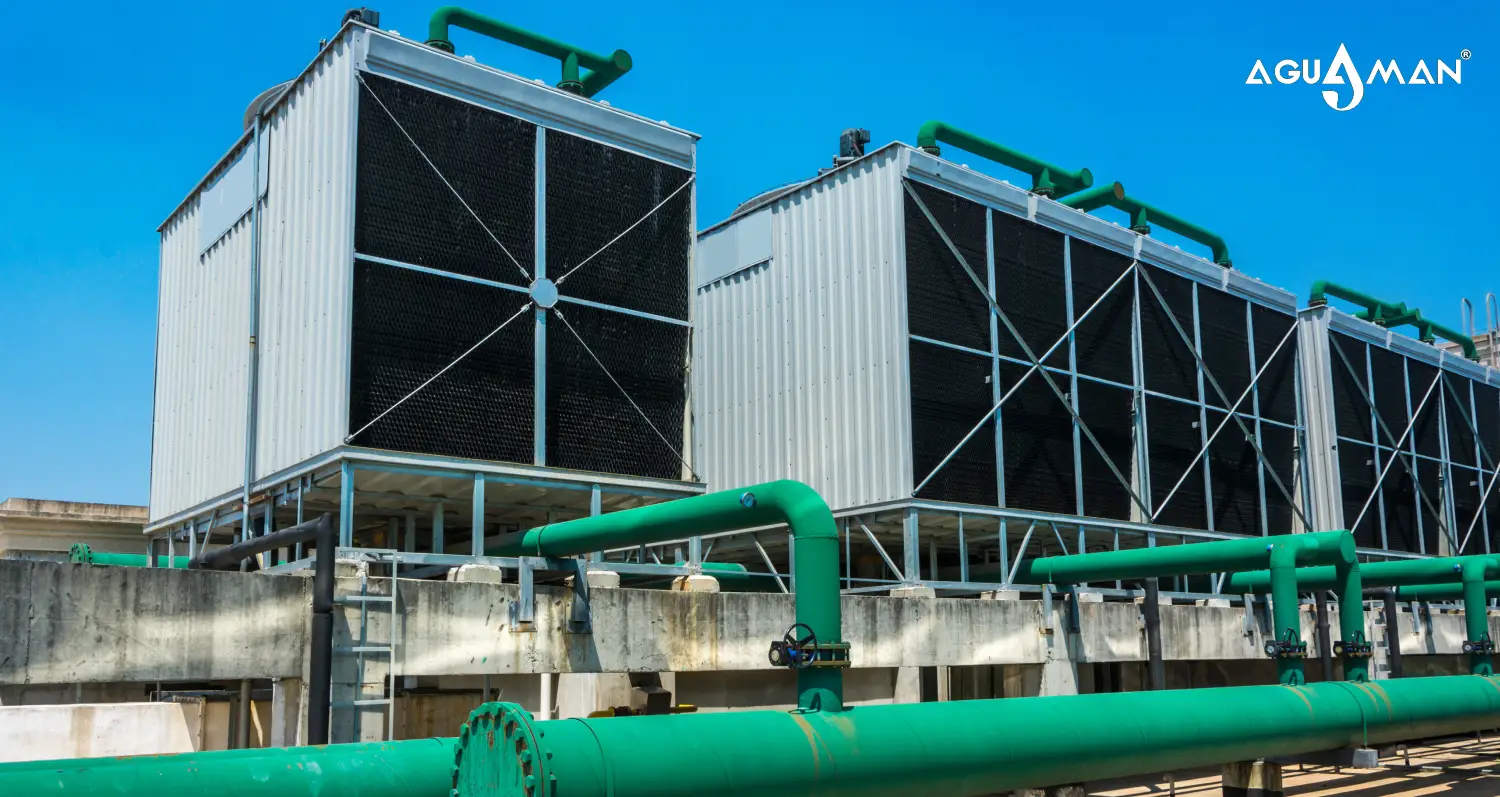
4. Cooling tower (for water-cooled systems)
For water-cooled systems, the cooling tower is where the heat that has been absorbed by the condenser water is rejected to the atmosphere.
5. Control system
Modern chilled water systems have automation and sensors that optimize energy consumption, flow rates and maintain a balanced temperature to provide reliable cooling with less waste.
Dubai-Specific Cooling Needs for Commercial and Industrial Facilities
Cooling equipment in Dubai faces year-round demand due to the area’s climate. Facilities and buildings that operate extended hours are under increased pressure to maintain cooling operations. For Business when evaluating industrial water & beverage chiller units in dubai, facility owners should look beyond equipment size. The right system will allow stable outlet temperatures, dependable circulation, energy-efficient operation, and longevity.
The ideal Dubai cooling system can combat losses in performance during peak summer months. For commercial buildings, this means maintaining occupant comfort. For industrial and beverage companies, the goal is precision control of water temperature. Temperature affects production processes, storage quality, equipment longevity, and process dependability. A Reliable chilled water supply can also limit downtime by maintaining cooling capacity at varying load conditions.
Owners should assess their operating hours, desired water temperature, pipe length, pump capacity, available space for installation, and access to equipment before choosing industrial water & beverage chiller units in dubai. Proper analysis will pair the chiller, pumps, controls, and distribution to the facility’s real cooling needs.
How Does a Chilled Water System Work?
It operates on a simple thermal cycle:
- Chilling: The chiller cools the water to approximately 6°C and pumps it through the supply loop.
- Absorption: As the chilled water passes through AHUs or FCUs, it absorbs heat from the building air.
- Return: The warmed water (around 12°C) returns to the chiller.
- Rejection: In a water-cooled chiller, heat is rejected through the cooling tower. In an air-cooled chiller, heat is rejected directly to the air.
This process repeats continuously, providing efficient cooling.
What are the Advantages of a Chilled Water System?
The following are advantages of a chilled water system
- Energy Efficient
Using water as the heat transfer medium (better than air) as well as variable-speed drives and state-of-the-art control systems will allow a higher efficiency.
- Ideal for Large Buildings
A single chilled water plant can serve several floors or even multiple buildings, which eliminates redundancy and makes maintenance more efficient.
- Better Indoor Air Quality
Since the air is being cooled centrally and is being blown through ducts, the humidity and temperature control will be more even and reliable, which results in healthier and more comfortable air.
- Cost effective in long run
Chilled water system’s initial cost may be higher than the traditional air conditioners, but they are far more energy-efficient, with lower operating and maintenance costs.
- Sustainable and Green Building Compliant
Amidst an increasingly strict energy conservation policies and carbon footprint measurement and tracking, chilled water system has been playing a major role in helping a building achieve LEED or green building certification.
Choosing Chilled Water Solutions for Office Buildings
Office buildings today face varying occupancy loads, meeting rooms, server rooms, glass façades and diversified floor usage patterns. This makes chilled water units for offices in dubai a favorable option in commercial projects that require centralized controls, scalability, and decades of dependable service life.
Efficiently sized chilled water supply will cool multiple zones throughout the office via AHUs or FCUs while allowing the central plant to efficiently balance the cooling load. This can benefit buildings such as office towers, business centers, clinics, showroom floors, co-working spaces and multi-use commercial buildings that experience fluctuations in cooling demand throughout the day.
Specifiers comparing chilled water units for offices in dubai should consider cooling capacity, compressor performance ratings, control integration, pump selection, acoustic ratings, serviceability and allowance for future capacity. Specifying a proper dubai cooling system should allow the building to operate efficiently during typical occupied hours as well as peak afternoon cooling demands.
High-Capacity Cooling for Large Facilities
Occasionally you will encounter buildings and processes that require cooling above and beyond comfort air-conditioning. Hotels, factories, warehouses, hospitals, data rooms, cold water supply for beverage plants, and large box space are examples where high capacity cold water cooling systems dubai are required to maintain operations.
Higher Capacity does not just mean higher output. Advantages also include better load matching, stable supply water temperature and conditioning of multiple terminal units from one central system. When specifying high capacity cold water cooling systems dubai for large facilities take into consideration redundancy, pump arrangement, control logic, heat rejection and maintenance access.
Design coordination is another important item for high capacity projects. The chiller supplier, MEP contractor, consultant and facility team should all be on the same page to avoid pressure mismatch, temperature instability, wasted energy and downtime after project completion.
Applications of Chilled Water Systems
You’ll commonly find chilled water systems in:
- Hospitals and Healthcare Facilities
- Shopping Malls and Airports
- Office Towers and Corporate Campuses
- Universities and Research Centers
- Manufacturing Plants
- Data Centers
Each of these environments requires large-scale, continuous cooling—something chilled water systems deliver reliably and efficiently.
Chilled Water Pipework and Distribution Planning
Pipe sizes, insulation levels, valve positioning, pump selection, flow balancing all contribute to the effective running of chilled water systems. Performance of even the most efficient chiller can suffer if the chilled water network that feeds it isn’t sized correctly. Both retrofit and new build projects should include chilled water pipework dubai planning alongside chiller unit specification.
Effective pipework layouts allow water temperature to remain stable between plant room and terminal units. Layouts also minimise potential condensation, pressure drop, flow noise and flow imbalance between temperature controlled zones. Ensuring your pipework layout considers these aspects is important for Dubai buildings; where long pipe runs to higher floors, rooftop units, confined plant rooms and higher ambient temperatures can all impact system performance.
Ideally chilled water pipework dubai layouts should be checked prior to installation to verify proposed routing is correct and confirms insulation thickness, spacing of supports, valve access, flushing points and allows for ease of maintenance. Addressing these often overlooked aspects of pipework design will improve commissioning reliability and allow for easier visual inspection, servicing and upgrading of your buildings cooling network going forward.
Why Are More Businesses Switching to Chilled Water Systems?
Global demand for energy-efficient HVAC systems is making chilled water a long-term strategic choice in infrastructure design. The integration of IoT controls, smart sensors, and AI optimization is providing facility managers with real-time cooling monitoring and up to 30% energy reduction capabilities.
In addition, organizations are incorporating water-cooled systems with heat recovery chillers for reusing waste heat in other processes in response to tightening sustainability regulations, which also improves total energy use.
Retrofit, Upgrade and Maintenance Considerations
Many existing buildings in Dubai operate with older cooling systems that may no longer match the current load. Changes in occupancy, added equipment, extended working hours, or modified interiors can increase cooling demand over time. In these cases, a chilled water system upgrade may improve comfort, reduce energy waste, and support better long-term performance.
A professional assessment should include the chiller condition, pump performance, water quality, pipe insulation, control settings, and terminal unit efficiency. For industrial and commercial sites, the review should also consider operational risk, spare parts availability, backup cooling needs, and planned maintenance schedules.
The best chilled water solution is not always the largest system. It is the system that is correctly selected, properly installed, easy to maintain, and suitable for the building’s real cooling profile.
Final Thoughts
A chilled water system is an investment in sustainable infrastructure, operational efficiency, and long-term cooling performance. For any scale of building or industrial plant, this technology provides unmatched reliability and energy optimization with the right design and maintenance.